
Most teams don’t have a hiring problem.
They have a screening problem.
They are spending hours reviewing resumes and running phone screens that don’t actually tell them who can sell in their environment. As a result, they end up interviewing candidates who were never a fit in the first place.
Resumes show where someone has been. They don’t tell you whether that person can succeed in your specific role, your sales motion, or with your buyers. And a 30-minute phone screen is often inconsistent and heavily influenced by gut feel.
If you want to improve hiring outcomes, you need a more structured way to evaluate candidates before they ever reach your calendar.
Here is what actually matters.
1. Role Fit: Are They Aligned with the Basics of the Role?
Most teams skip this step and jump straight into interviews. That is where the process breaks down.
Before anything else, you need to confirm that the candidate’s baseline profile aligns with what you are hiring for.
For AEs and SDRs, that includes:
Compensation expectations vs your range
Quota history relative to your targets
Sales motion experience, inbound vs outbound
Work preference, remote, hybrid, or in-office
A candidate who has only worked inbound will struggle in a high-activity outbound SDR role. Someone expecting a $100K base when your role is at $65K is not a viable hire.
These are not minor details. They are disqualifiers that should be identified immediately, not after multiple interviews.
2. Experience Fit: Have They Sold in a Similar Environment?
Experience is not about logos. It is about context.
Two candidates can both claim enterprise experience and be completely different in terms of what they have actually done.
What matters:
Average deal size compared to your ACV
Sales cycle length, transactional vs multi-month
Industry exposure and familiarity with your market
Buyer personas they have sold to
An AE closing $500K deals may not be motivated in a $15K SMB role. Someone from a fast, transactional environment may struggle in a complex, procurement-driven cycle.
Relevant experience is about alignment with your environment, not just years of experience.
3. Sales Alignment: Do They Sell the Way Your Team Sells?
This is one of the most overlooked factors and one of the most predictive of success.
Even strong salespeople fail when their natural approach does not match how the team operates.
Sales alignment includes:
Prospecting style, hunter vs relationship-driven
Familiarity with your methodology, MEDDIC, Challenger, SPIN
Selling motion, outbound, product-led, channel, referral
Preferred sales cycle, fast-paced vs consultative
A mismatch here creates friction immediately. It leads to retraining, inconsistent performance, and often early turnover.
This is especially critical for SDRs, where activity level, consistency, and adherence to process are non-negotiable.
4. Culture Fit: Will They Thrive in Your Sales Environment?
In sales, culture is not about perks or values statements.
It is about how performance is managed day to day.
Some teams are highly structured with tight coaching and accountability. Others expect reps to operate independently with minimal oversight.
Look at:
Coaching preference, structured vs autonomous
Work pace, startup vs established environment
Team dynamic, collaborative vs individual-driven
Expectations around activity, pipeline, and performance
Put the wrong person in the wrong environment and performance drops quickly, regardless of skill level.
5. Stability: What Does Their Career Pattern Tell You?
Tenure trends are one of the most underused signals in sales hiring.
A single short stint is not a concern. A consistent pattern is.
Evaluate:
Average tenure across roles
Frequency of roles under 12–18 months
Gaps or unclear transitions
If your ramp time is 6 months and a candidate has never stayed longer than 14 months, that is a real risk to the business.
This is not about penalizing candidates. It is about understanding patterns before you invest in onboarding and ramp.
The Reality Most Teams Ignore
If you look at those five areas closely, you will notice something.
The framework for evaluating candidates is the same every time.
But the criteria inside that framework should change based on the role you are hiring for.
An outbound SDR role, a mid-market AE role, and an enterprise expansion role should not be evaluated the same way. The deal size, sales cycle, buyer, motion, and expectations are completely different.
Yet most teams run the same generic screening calls anyway.
Same questions.
Same flow.
Same 20–30 minutes spent trying to determine basic fit before deciding if someone is worth moving forward.
It is repetitive. It is time-consuming. And it is inconsistent depending on who is running the call.
A Better Way to Screen Candidates
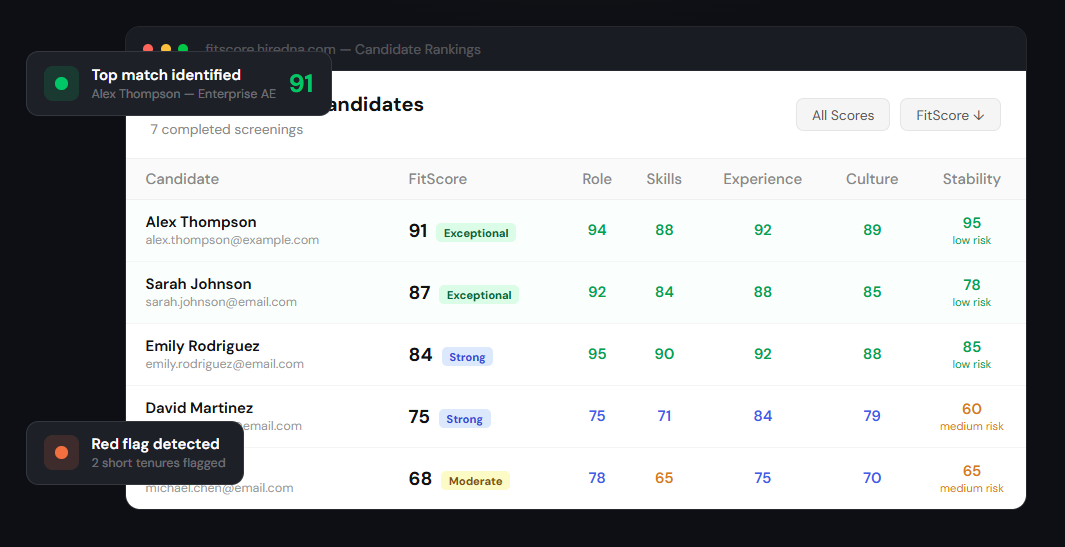
FitScore was built to eliminate that redundancy while customizing evaluation to your exact role.
You define your ideal selling profile, including deal size, sales cycle, buyer type, compensation, and sales motion.
FitScore then screens every candidate against that profile.
Instead of spending 30 minutes on a call asking the same questions over and over, FitScore captures and evaluates all of that upfront in a structured, consistent way.
The result is a faster, more effective process for both sides.
Your team no longer wastes time on candidates who are clearly misaligned.
Candidates are not stuck in early-stage screening calls that go nowhere.
And instead of relying on a resume, a LinkedIn profile, and a subjective call summary, you get structured, data-driven insight with clear recommendations on every candidate.
It goes deeper than a phone screen.
It is more consistent than an internal process.
And it gives you a clearer picture of who is actually worth your time.
Stop Screening. Start Evaluating.
If your team is still spending hours on early-stage screening calls, you are solving the wrong problem.
You do not need more candidates.
You need a better way to evaluate them.
FitScore replaces the most repetitive and inefficient part of the hiring process with a structured, role-specific evaluation that surfaces the right candidates before you ever get on the phone.
If you want to see how your current candidates stack up, test it yourself.
You will immediately see the difference between reviewing resumes and actually understanding who fits your role.