
Many hiring teams assume that a longer interview process reduces hiring risk and produces better results. The logic feels reasonable. More interviews should lead to better hiring decisions and fewer costly sales hiring mistakes.
In practice, longer interview processes rarely produce better sales hires. More often, they slow down the sales hiring process, introduce friction, and push the best sales talent out of the funnel. What improves hiring outcomes is not the number of interview stages, but clarity around what you are hiring for and a structured sales interview process designed to validate it.
High-performing sales teams do not hire faster because they cut corners. They hire faster because they have a clear sales hiring strategy and an interview process that filters for the right candidates early.
Why Sales Interview Processes Get Bloated
Long interview processes are rarely intentional. They are usually symptoms of a broken sales hiring process.
They tend to emerge when:
The ideal sales candidate profile is unclear
Sales hiring criteria are not well-defined
Interviewers are not aligned on what good looks like
Decision-making authority is fragmented
Teams try to reduce risk by adding more interviews
Each additional interview is added to increase confidence and buy-in, but confidence does not come from repetition. It comes from structure. Research published by Harvard Business Review shows that unstructured interviews are weak predictors of job performance and that adding more interviews increases bias rather than improving hiring accuracy.
At a certain point, more interviews stop improving sales hiring decisions and start actively hurting them.
What an Effective Sales Hiring Process Looks Like
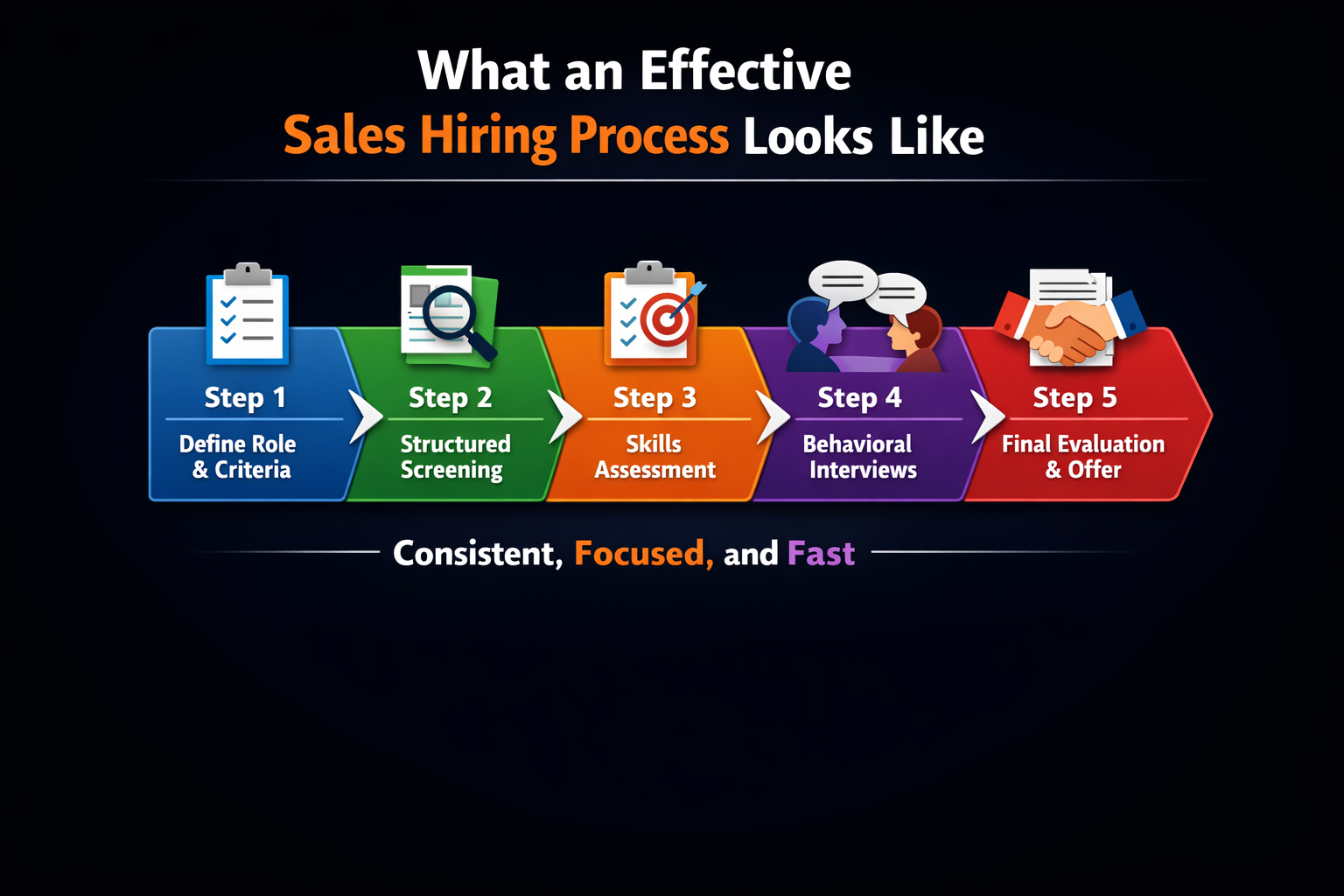
For most sales roles, including SDRs, Account Executives, Account Managers, and frontline sales managers, a four-step sales interview process is more than sufficient when executed correctly.
If you cannot determine whether a sales candidate is a fit within these four steps, the problem is almost never the candidate. It is the sales hiring system.
Step 1: Structured Sales Screening
Confirm alignment and mutual fit early
The purpose of the sales screening call is to confirm baseline alignment, mutual fit, and interest.
This step should validate:
Previous sales roles and progression
Sales experience and sales motion
Average deal size and sales cycle length
Quota attainment and performance history
Compensation expectations
The candidate’s ideal next sales role
This step should be consistent across every candidate and focused on facts. It can be standardized and automated using a tool like FitScore, which ensures every sales candidate is screened against the same hiring criteria before moving forward.
Weak screening is one of the biggest causes of slow sales hiring and mis-hires.
Step 2: Sales Skills Assessment
Evaluate selling ability before investing more time
Sales interviews often overemphasize confidence, presentation, and storytelling. While important, these traits do not predict whether someone can execute your unique sales process.
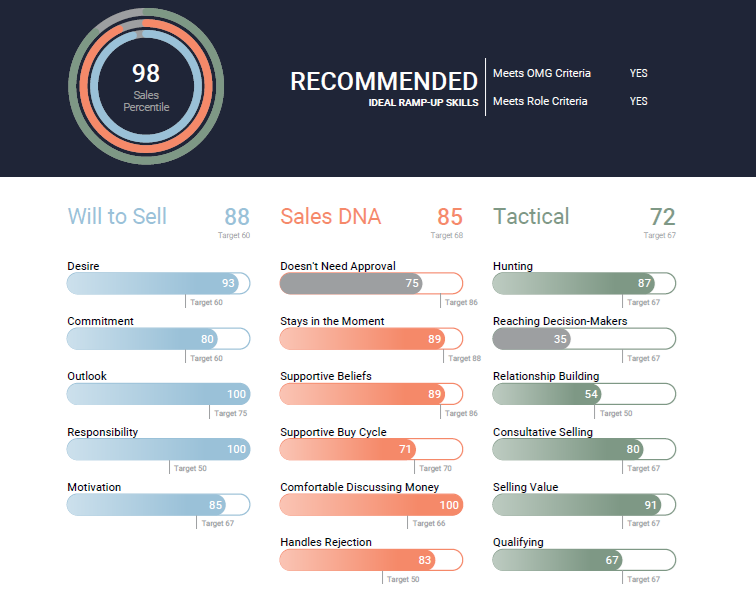
A science-backed tool like the OMG Sales Candidate Assessment provides objective insight into a candidate’s selling skills, abilities, and behaviors, including:
Prospecting and hunting capability
Sales process execution
Comfort discussing money
Resilience and recovery from rejection
Coachability, drive, and motivation
This step answers a critical question early in the sales hiring process: does this candidate actually have the selling skills required to succeed in this role?
Skipping a sales assessment is one of the most common sales hiring mistakes companies make.
Step 3: Deep Dive Sales Interview
Understand how the salesperson actually operates
This is the most important interview in the entire sales interview process.
The deep dive interview should be structured, role-specific, and built around behavioral and situational questions. The goal is not to rehash the resume, but to understand how the salesperson thinks, reacts, makes decisions, and navigates real sales scenarios.
This is where you validate:
Sales metrics and KPIs discussed during screening
Findings from the sales assessment
How the candidate runs deals and engages buyers
Team collaboration and accountability
Culture and values alignment
How they learn and recover from unfavorable outcomes
When this interview is done well, there is little ambiguity left about whether the candidate can succeed.
Step 4: Final Sales Interview and Close
Confirm alignment and secure commitment
The final interview should confirm alignment, not uncover new information.
This may include a mock presentation, deal walkthrough, or panel interview. Part of the discussion should focus on how the candidate prepares, communicates, positions value, and engages stakeholders. The remaining time should reconfirm expectations around role responsibilities, compensation, timelines, and success criteria.
A strong sales hiring process naturally leads to verbal acceptance before a formal offer is extended. If it's a fit, be prepared to make a decision and verbal offer here.
How Often Should Final Sales Interviews Result in Hires?
There is no universal benchmark, but recruiting data and retained search benchmarks show that healthy sales hiring processes convert roughly 25% to 40% of final-stage sales candidates into offers or hires.
If your conversion rate is consistently below that range, it usually indicates:
Poor sales candidate screening
Misaligned interviewers
Compensation or expectation mismatches
An unclear ideal sales candidate profile
Adding more interview steps does not fix these issues. It hides them.
Why Long Interview Processes Push Top Sales Talent Away
Top sales performers move quickly because they can. They understand their market value and pay close attention to how companies make hiring decisions.
Top candidates are often off the market within 10 to 14 days, while many companies take up to 44 days to complete their interview process.
Long, repetitive sales interview processes communicate indecision and internal misalignment. Strong candidates interpret this as a red flag and disengage. Companies believe they are being selective when in reality they are filtering out the best sales talent.
The Cost of Over-Interviewing Sales Candidates
Every additional interview step increases:
Time to fill sales roles
Opportunity cost from missed revenue
Candidate fatigue
Internal confusion
It also dilutes accountability. When too many people are involved in interviewing, no one truly owns the sales hiring decision.
That is how mis-hires happen, even after six or seven interviews.
Pressure Testing Your Sales Hiring Process
If sales roles stay open too long, offer acceptance rates are low, or new hires struggle to ramp, the issue is rarely just a lack of quality candidates.
It is usually a flawed sales hiring process.
Check out our free Hiring Readiness Assessment, which helps companies evaluate their sales interview process, hiring criteria, and decision-making alignment to identify gaps that lead to unfilled roles, high turnover, and missed quotas.
Get your readiness report with instant results and recommendations to improve your sales hiring process.