
A role opens up. Someone drafts a job description. It gets posted. Résumés start coming in. Interviews get scheduled.
Most hiring teams think that’s where the process starts.
It’s not. And that gap between where the process actually should start and where most teams begin is exactly where hiring goes wrong.
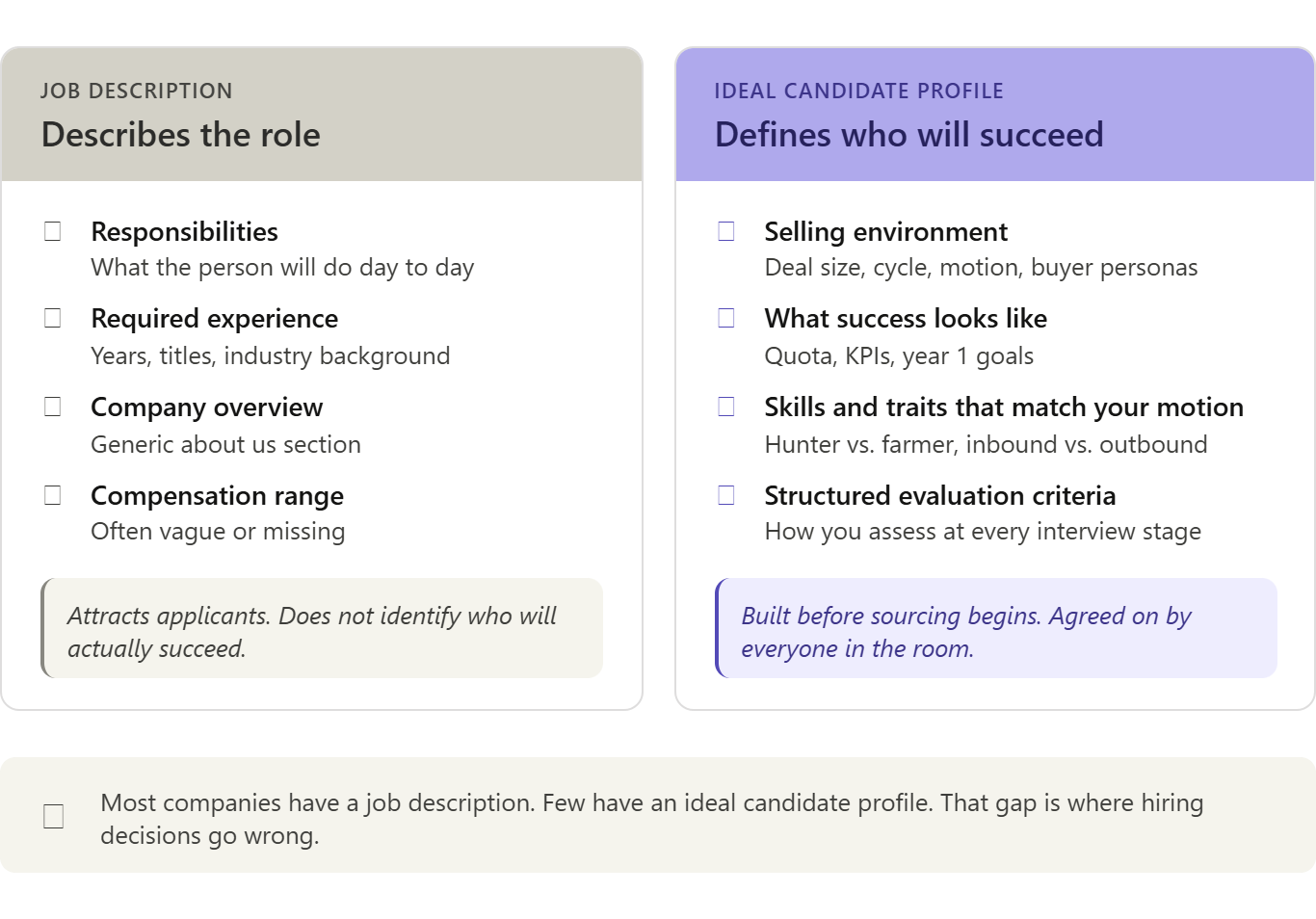
A Job Description Is Not an Ideal Candidate Profile
There’s a fundamental difference between describing a job and defining the person who will succeed in it. A job description tells you what the role is. An ideal candidate profile tells you what someone needs to successfully perform in it.
Most companies have the first. Very few have the second.
When I work with a new client, one of the first things I do is walk them through a structured intake process before we source a single candidate. What I find almost every time is that the team hasn’t fully thought through what they actually need. They’ve thought about what the job requires. That’s not the same thing.
The Warning Signs Are Easy to Spot
When a client can’t tell me what success looks like in this role, I know we’re going to have a problem.
Here’s what that looks like in practice. I ask straightforward questions and get answers like:
“We’ll know it when we see it.”
“We want someone with industry experience.”
“Quota is around $800K… roughly.”
“We’ll figure out the interview process as we go.”
I hear versions of this constantly. And when a team can’t answer basic questions before sourcing begins, the entire hiring process is built on guesswork.
The most common gaps I see:
No clear compensation structure. Not just base and OTE. Actual quota, commission structure, ramp plan, and whether those numbers are real or aspirational. I’ve seen quotas set at levels no rep has ever hit. That’s not a comp plan, it’s a fantasy.
Can’t articulate the selling environment. Average deal size. Sales cycle. Target buyer. Whether this is inbound or outbound, hunter or farmer. These aren’t nice-to-haves. They define what kind of seller you actually need.
Can’t answer why a candidate would be excited about this role. Top performers aren’t applying to job postings. They’re being recruited. If you can’t clearly articulate what makes this opportunity compelling, you won’t land them.
The hiring team isn’t aligned. Sales wants one thing. The founder wants another. TA is trying to manage both. Without alignment before the process starts, you end up interviewing forever and deciding on nothing.
No defined interview process. Not just how many rounds. What each stage is evaluating, who’s involved, and how a decision gets made. “We’ll have them pitch our product” is not an evaluation strategy.
What an Actual Ideal Candidate Profile Covers
Before we build a job posting or source a single candidate, we build out a complete role profile. It goes deep, and it has to be completed and agreed upon by everyone involved in the hiring decision before the process begins.
It covers the company: culture, value prop to candidates, sales team structure, how reps are supported, average tenure, what percentage of reps actually hit quota.
It covers the selling environment in detail: deal size, sales cycle, target market, buyer personas, territory, account type, and motion: inbound vs. outbound, hunter vs. farmer.
It covers the candidate specifically: must-have vs. nice-to-have experience, required skills, personality traits, characteristics that match the sales motion, and clear qualification criteria for screening.
And it covers the interview process end-to-end: each stage, what’s being evaluated at that stage, who’s in the room, and how a final decision gets made.
This isn’t a wishlist. It’s a hiring system. And it has to be built before you go to market, not during.
What Happens When You Skip It
The cost of skipping this step isn’t always obvious up front. It shows up later, in ways that are hard to connect back to the root cause.
You run too many interviews. Without clear criteria, every candidate gets a full process because no one can confidently say yes or no early. Time is wasted on both sides.
Good candidates drop off. Passive candidates, the ones who are already performing somewhere, won’t endure a disorganized process with no clear timeline or value proposition. They move on.
Decisions become subjective. When there’s no defined criteria, feedback sounds like: “We’re going to pass.” “They’re not a fit.” “We just didn’t feel it.” Nothing quantifiable. Nothing actionable. You spend months chasing a feeling you can’t define.
And sometimes you make the hire anyway, out of urgency or exhaustion, and the person who looked good in interviews struggles to perform in the role. Not because they weren’t talented, but because no one ever defined what “good” actually looked like for this specific opportunity.
The Mindset Shift That Changes Everything
The teams that hire well don’t treat sourcing as the starting line. They treat it as step three or four, after they’ve done the internal work of defining who they need, why someone would want the role, and exactly how they’ll evaluate candidates fairly and consistently.
Defining your ideal candidate before you go looking for them isn’t extra work. It’s the work. Everything else is downstream of it.
Get that right, and the rest of the process gets faster, cleaner, and a lot less expensive.
Not Sure Where Your Hiring Process Stands?
Before you open your next sales role, it’s worth knowing where the gaps are. We built a free Sales Hiring Readiness Assessment that scores your process across eight categories, benchmarks you against 500+ other companies, and tells you exactly what to fix first.
It takes about 10 minutes. You’ll walk away with a personalized score, a breakdown of where you’re strong and where you’re losing candidates, and a complimentary session with a hiring expert to build your action plan.